We have compiled a list of manufacturers, distributors, product information, reference prices, and rankings for Tolerance measuring equipment.
ipros is IPROS GMS IPROS One of the largest technical database sites in Japan that collects information on.

Tolerance measuring equipment Product List and Ranking from 4 Manufacturers, Suppliers and Companies

Tolerance measuring equipment Product List

1~4 item / All 4 items

Displayed results

What is tolerance? The "allowable range" necessary for manufacturing!

Introducing columns on topics such as "Various Tolerances," "Types of Geometric Tolerances," and "Tolerances and Measurement/Inspection"!

In this column, we will provide a detailed explanation of tolerances. A tolerance is the range of values that is acceptable even if it deviates from the target value. To account for measurement uncertainty and clarify the required range of precision, all dimensions in drawings include tolerances, making it clear what deviations are permissible. [Contents] ■ What is a tolerance ■ Various types of tolerances ■ Types of geometric tolerances ■ Tolerances and measurement/inspection ■ Conclusion *For detailed content of the column, please refer to the related links. For more information, feel free to contact us.

  • others

Added to bookmarks

Bookmarks list

Bookmark has been removed

Bookmarks list

You can't add any more bookmarks

By registering as a member, you can increase the number of bookmarks you can save and organize them with labels.

Free membership registration

The characteristics of 'geometric tolerances' that serve as a standard for indicating processing accuracy.

Introduction to the characteristics of geometric tolerances, which are effective standards for achieving high precision.

To manufacture and process according to customer requests, it is necessary to have design capabilities to shape those requests, along with high-precision technology that faithfully realizes that design. One effective criterion for judging whether processing is being carried out faithfully to the design is the characteristics defined by geometric tolerances. Geometric tolerances are divided into four categories: "shape," "orientation," "location," and "runout," with 19 types of characteristics established. 【Shape Tolerances】*Indicates the accuracy of geometric shapes. ■ Straightness - Whether the center of the processed item, generatrix, etc., is accurate as a straight line. ■ Flatness - Whether the surface of the processed item is flat and free of undulations. ■ Roundness - Whether the curvature of the circular part of the processed item is accurate as a circle. - Includes shaft parts and conical processed items. ■ Cylindricity - Indicates the degree of accuracy of cylindrical processed items. ■ Profile of a line - The minimal distortion in the line part that indicates the contour of the processed item. ■ Profile of a surface - The minimal distortion in the surface part that indicates the contour of the processed item. *For more details, please refer to the external link or feel free to contact us.

  • Processing Contract
  • Contract manufacturing

Added to bookmarks

Bookmarks list

Bookmark has been removed

Bookmarks list

You can't add any more bookmarks

By registering as a member, you can increase the number of bookmarks you can save and organize them with labels.

Free membership registration

Glossary: Explanation of Types and Notation of Geometric Tolerances!

"True roundness" specifies "perfect roundness"! It explains many aspects such as "positioning" and "circular axis degree"!

This document is a glossary explaining the types and notation of geometric tolerances. It includes terms such as "perpendicularity," "slope," "concentricity," and "symmetry." "Circular runout" must be within the specified range when the part is rotated and the measurement values fluctuate. Please feel free to download and read it. [Contents] ■ Perpendicularity ■ Slope ■ Concentricity ■ Symmetry ■ Parallelism *For more details, please refer to the PDF document or feel free to contact us.

Added to bookmarks

Bookmarks list

Bookmark has been removed

Bookmarks list

You can't add any more bookmarks

By registering as a member, you can increase the number of bookmarks you can save and organize them with labels.

Free membership registration

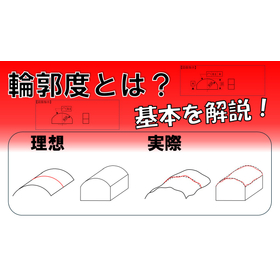
What is contour accuracy for measuring instruments? An explanation of the basics!

A clear explanation of the basics of contouring in a video!

In the measurement equipment industry, a precise understanding of geometric tolerances on drawings is essential to guarantee the accuracy of products. In particular, contour accuracy is a crucial factor in evaluating the shape precision of products, and understanding its definition and application methods is indispensable for quality management in design and manufacturing. A lack of understanding of contour accuracy can lead to incorrect measurements and the occurrence of defective products. This video explains the definition of contour accuracy, examples of its use, how it is applied on drawings, and points to be cautious about when using it. By learning the fundamentals of contour accuracy, you will contribute to improving quality in the design and manufacturing of measurement equipment. 【Usage Scenarios】 - Reading drawings in the design and manufacturing of measurement equipment - Promoting understanding of geometric tolerances among quality management personnel - Educational tool for engineers 【Benefits of Implementation】 - Improved quality in design and manufacturing through accurate understanding of contour accuracy - Enhanced drawing interpretation skills - Reduction of quality issues

Added to bookmarks

Bookmarks list

Bookmark has been removed

Bookmarks list

You can't add any more bookmarks

By registering as a member, you can increase the number of bookmarks you can save and organize them with labels.

Free membership registration